Basement Wall Repair Tulsa OK
Basement wall repair is among the most urgent foundation services we perform for Tulsa homeowners. A bowing, cracking, or inward-leaning basement wall is not a cosmetic issue — it is a structural failure in progress. Oklahoma’s expansive clay soils exert enormous lateral pressure against basement walls, and once a wall begins to deflect inward, the movement accelerates unless it is arrested with the correct stabilization method. At Tulsa Foundation Repair, we assess every wall failure accurately and apply proven repair methods that stop movement and restore structural integrity.
The warning signs of a failing basement wall are often visible before the problem becomes critical. Horizontal cracks running across the middle third of a block wall are the most serious indicator — they form where lateral soil pressure is greatest and signal that the wall is beginning to bow inward. Stair-step cracks along mortar joints indicate differential settlement at the corners. Vertical cracks near the centre of a poured concrete wall can indicate tension failure from outward slab movement. Any crack that is widening over time, or any wall that visibly leans inward when viewed from the basement floor, requires immediate professional assessment.
Why Basement Walls Fail in Tulsa
Tulsa’s geology creates some of the most demanding conditions for below-grade wall systems in the region. The Verdigris and Arkansas river floodplains that define much of the Tulsa metro’s geography are underlain by highly plastic clay soils with shrink-swell potential that exceeds most of the surrounding Oklahoma landscape. In established residential areas — including the older neighbourhoods of North Tulsa, the midtown corridor between Peoria Avenue and Harvard Avenue, and the hillside properties of the Maple Ridge and Swan Lake areas — basement walls have been subjected to decades of seasonal soil pressure cycles.
The mechanics of wall failure in Tulsa follow a predictable pattern. Each spring, saturated soils expand and push against the wall. Each dry summer, the soil contracts and pulls away, removing the passive support the wall relied on. Over years and decades, this cycle causes the wall to creep inward incrementally. The steel reinforcement in older block walls — where present at all — corrodes as moisture infiltrates through the mortar joints, reducing the wall’s tensile capacity precisely when it needs it most. By the time most Tulsa homeowners notice a problem, the wall has often already deflected several inches from its original vertical position.
Newer homes in the outer Tulsa suburbs are not immune. Concrete block and poured concrete walls in developments built on filled or graded lots — common in rapidly developed areas of south Broken Arrow, east Owasso, and the newer Bixby subdivisions — can fail within ten to fifteen years if the backfill was not properly compacted or the drainage behind the wall was inadequate at construction.
Basement Wall Repair Methods
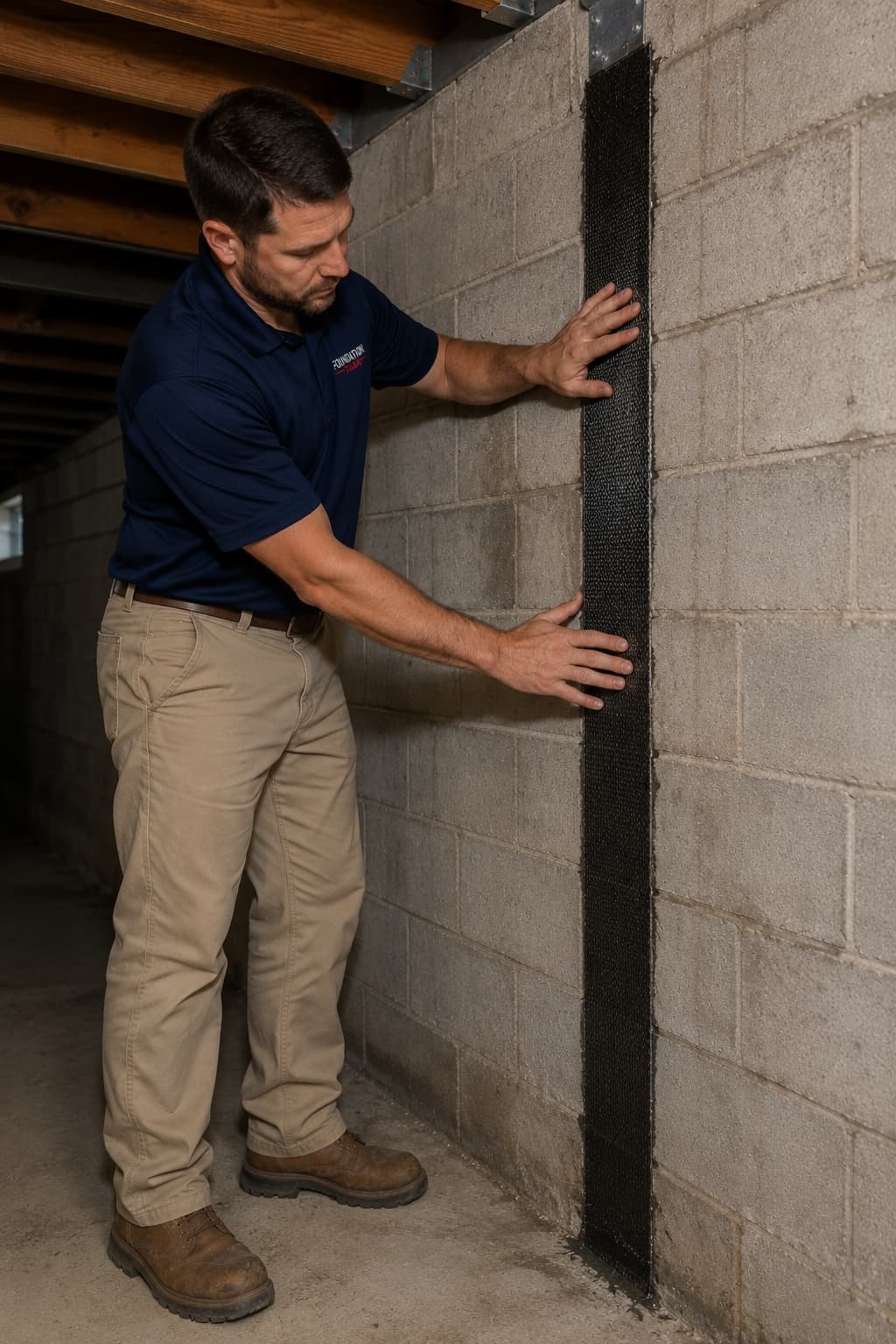
- Carbon fiber strap stabilization — The most widely used method for walls with less than two inches of inward deflection. High-strength carbon fiber straps are bonded vertically to the wall surface using structural epoxy, transferring the lateral load to the floor slab at the base and the floor system above. Straps are low-profile, require no excavation, and can be installed in a single day. Carbon fiber does not rust, rot, or lose tensile strength over time.
- Steel I-beam installation — For walls with greater deflection or where the wall continues to move despite strap installation, steel I-beams are installed vertically against the wall face, anchored to the floor and ceiling. Beams can be gradually tightened over time to push the wall back toward its original position — the only repair method that allows for active wall straightening after installation.
- Helical wall anchor installation — Helical anchors are screwed through the wall into the stable soil beyond the failure zone, then tensioned to pull the wall outward and halt inward movement. Effective where sufficient yard space exists to install the anchor rods at the required distance from the foundation. Can be gradually tensioned over successive seasons to restore wall alignment.
- Wall rebuilding — For walls that have deflected beyond repair thresholds or that have suffered significant structural deterioration, partial or full wall rebuilding may be the only appropriate solution. This is the most disruptive and expensive option and is reserved for situations where stabilization methods cannot safely arrest the failure.
Basement Wall Repair Pricing in Tulsa
Repair costs depend on the wall length, degree of deflection, repair method, and whether drainage improvements are needed alongside the structural work. Typical Tulsa residential ranges:
- Carbon fiber strap installation — $1,200–$2,000 per strap; most walls require 3–5 straps ($4,000–$10,000)
- Steel I-beam installation — $1,500–$2,500 per beam; most walls require 3–5 beams ($5,000–$12,500)
- Helical wall anchor installation — $1,500–$2,500 per anchor; typically 3–5 anchors per wall ($5,000–$12,500)
- Wall rebuild (partial) — $8,000–$18,000 depending on the section length and access requirements
- Wall rebuild (full) — $18,000–$40,000 including excavation, demolition, new wall construction, and backfill
Carbon fiber strap installation is the most cost-effective first-line intervention for walls in the early to moderate stages of deflection. The window for using this method closes once deflection exceeds approximately two inches — at that point, more invasive methods are required. Early action is always the lower-cost outcome.
Frequently Asked Questions
How much wall movement is too much before it becomes an emergency?
Any inward deflection greater than one inch should be professionally assessed without delay. Walls that have moved two inches or more are approaching the threshold where carbon fiber stabilization alone may be insufficient and more invasive repair methods will be required. Horizontal cracks that run the full width of a wall, or walls where the crack is wider at one face than the other, indicate active structural failure and should be treated as urgent. If you can see daylight through a crack or the wall has visibly separated from the floor slab, contact us immediately.
Can a bowing wall be straightened after repair?
Steel I-beams and helical wall anchors both allow for gradual wall straightening after installation by incrementally tightening the anchoring system over one to three years. Full restoration to the original wall position is not always achievable, but meaningful improvement in alignment is realistic in most cases. Carbon fiber straps arrest movement permanently but do not allow for subsequent straightening — they are the correct choice when halting movement is the goal and cosmetic alignment is secondary.
Will repairing the wall also fix the water coming through it?
Wall stabilization and waterproofing address different problems and are often needed together. Stabilisation stops structural movement; waterproofing manages water infiltration. A bowing wall that is also leaking will typically need both services — the wall repair first to arrest movement, followed by waterproofing to manage the water that continues to seep through the cracks and joints. We assess both needs during the initial inspection and provide a combined scope where both are required.
Do I need a structural engineer’s report for basement wall repair?
For most residential wall repair jobs using carbon fiber straps or I-beams, a qualified foundation repair contractor can assess and repair without a structural engineer. If the wall has deflected significantly, if the repair will be used to support a mortgage transaction or insurance claim, or if local building permits require engineering sign-off, a structural engineer’s report will be needed. We advise on this during the initial assessment and can recommend licensed structural engineers in the Tulsa area if required.
Service Areas
We carry out basement wall repair across Tulsa and the surrounding communities. Visit your local page for area-specific information:
- Foundation Repair Broken Arrow
- Foundation Repair Owasso
- Foundation Repair Bixby
- Foundation Repair Jenks
- Foundation Repair Sand Springs
- Foundation Repair Sapulpa
A bowing or cracking basement wall will not stabilise on its own — in Tulsa’s clay soil environment, unaddressed wall movement accelerates with every seasonal pressure cycle. The National Foundation Repair Association recommends that any visible inward wall movement be professionally assessed within 30 days of discovery. Call Tulsa Foundation Repair at (918) 359-6999 or use our Free Estimate page to schedule your inspection today.
📞 Call (918) 359-6999