
Foundation Waterproofing Tulsa OK
Foundation waterproofing Tulsa homeowners rely on to keep basements and crawl spaces dry is more than just a cosmetic fix — it is a structural investment that protects the long-term integrity of your home. Tulsa receives an average of 40 inches of rainfall per year, with the heaviest precipitation concentrated in spring and early summer. When that water has nowhere to go, it finds the path of least resistance — which is almost always your foundation wall. At Tulsa Foundation Repair, we install professional-grade waterproofing systems designed to manage water permanently, not temporarily.
Many Tulsa homeowners first attempt to address basement water with surface sealants or exterior drainage improvements. While exterior grading and downspout extensions are worthwhile maintenance steps, they rarely solve chronic water infiltration caused by hydrostatic pressure — the pressure that builds up in saturated clay soil and pushes water through concrete block walls, poured concrete cracks, and the critical wall-floor joint at the base of your basement. A properly engineered interior waterproofing system captures and redirects that water before it can damage your foundation, flooring, or stored belongings.
Why Waterproofing Is Essential for Tulsa Homes
The combination of Tulsa’s rainfall patterns and the clay-dominant soils beneath the city creates some of the highest hydrostatic pressure conditions in the south-central United States. During a heavy spring rain event — and Tulsa experiences multiple rainfall events exceeding two inches in a single day throughout April and May — the soil surrounding a basement foundation can become fully saturated within hours. Fully saturated clay soil exerts lateral pressure against foundation walls that can exceed 30 pounds per square foot at depth.
Older Tulsa neighbourhoods present particular waterproofing challenges. Homes in established areas like South Tulsa, Midtown, and the corridors around Riverside Drive were frequently built with concrete block foundations — a wall type that is inherently more porous than poured concrete. Water infiltrates through the mortar joints between blocks even where the blocks themselves remain intact. Tuck-pointing delays the problem; a managed drainage system solves it.
Newer slab-on-grade homes in the outer Tulsa suburbs — areas like Owasso, Bixby, and the southern Broken Arrow developments — face a different but related problem. Expansive clay soils that shrink away from the foundation perimeter during dry summers create gaps that channel surface water directly down to foundation level during subsequent rain events. The result is concentrated water infiltration at the perimeter of the slab, leading to undermining of the slab edge and eventual settlement.
Our Foundation Waterproofing Process
- Water infiltration assessment — We identify every point of water entry: wall cracks, mortar joint seepage, wall-floor joint infiltration, and floor seepage. We also assess exterior drainage conditions, downspout discharge, and window well drainage to identify above-grade contributors to the problem.
- System design — Based on the assessment, we design an interior drainage system sized for your basement’s square footage and the volume of water the system needs to manage. This includes the drainage channel specification, sump pit location, sump pump capacity, and any wall membrane requirements.
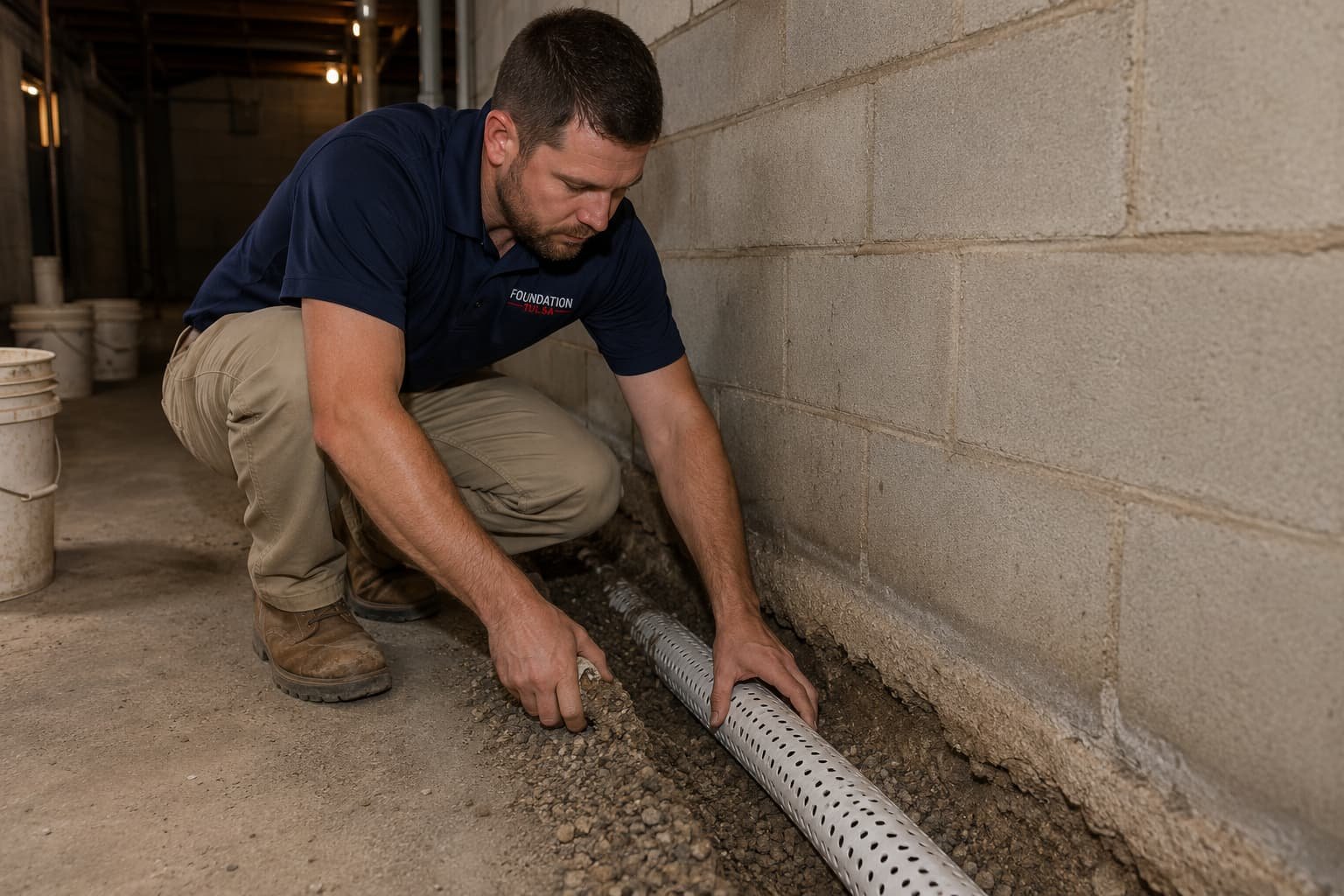
- Interior drain tile installation — A perforated drain tile channel is installed along the interior perimeter of the basement floor, below the slab level. This requires saw-cutting the concrete floor, excavating a trench, installing the drain tile in clean gravel, and re-pouring the concrete over the top. The finished surface looks like a narrow seam at the wall-floor joint.
- Sump pump installation — Water collected by the drain tile system flows to a sump pit, where a submersible pump automatically discharges it away from the foundation. We install reliable, properly sized pumps with battery backup systems to ensure the system continues operating during power outages — which in Tulsa often coincide with the heaviest rain events.
Foundation Waterproofing Pricing in Tulsa
Waterproofing system costs depend on the size of the area being waterproofed, the severity of water infiltration, and the components required. The following ranges reflect typical Tulsa residential installations:
- Interior drain tile system (partial perimeter) — $4,500–$8,000 for a single wet wall or corner treatment covering 20–40 linear feet
- Interior drain tile system (full perimeter) — $8,000–$18,000 for a full basement perimeter installation; price varies with basement size and concrete thickness
- Sump pump installation (new pit) — $1,200–$2,500 including pit excavation, liner, pump, and discharge line
- Battery backup sump pump addition — $400–$900 added to a primary pump installation
- Wall membrane system — $2,000–$5,000 for a dimple mat or drainage board membrane covering a wet wall, directing seepage to the drain tile below
- Combined system (drain tile + sump + membrane) — $10,000–$22,000 for a comprehensive full-basement solution
Frequently Asked Questions
What is the difference between interior and exterior waterproofing?
Exterior waterproofing involves excavating around the foundation perimeter, applying a waterproof membrane to the outside face of the foundation wall, and installing drainage board and perimeter drain tile at the footing level. It is the most comprehensive solution but also the most disruptive and expensive — typically $20,000–$40,000 for a full perimeter. Interior waterproofing manages water after it enters the wall system, capturing it before it reaches the living space and discharging it via a sump pump. Interior systems are less expensive, require no excavation, and are highly effective for the majority of Tulsa residential waterproofing situations.
Will waterproofing stop my basement walls from cracking further?
A waterproofing system manages water infiltration but does not address the structural causes of wall cracking — soil pressure, settlement, or lateral movement. If your walls are actively bowing, cracking, or deflecting inward, wall stabilization using carbon fiber straps or helical tiebacks should be completed before or alongside the waterproofing installation. Our assessment process evaluates both the water management needs and the structural condition of your walls so that the correct combination of work is specified from the start.
How long does a waterproofing installation take?
A full perimeter interior drain tile installation in a typical Tulsa basement takes three to five days. Partial perimeter treatments covering one or two walls are typically completed in one to two days. Sump pump installation on an existing system takes half a day. Concrete breaking and re-pour are included in our scope — you will have a clean finished floor when we leave, not an open trench.
Does the sump pump need maintenance?
Sump pumps should be tested annually — pour water into the pit to confirm the float activates the pump and water is discharged correctly. The pit should be inspected for debris accumulation every two to three years. Battery backup systems should have their batteries replaced every three to five years regardless of apparent condition. We provide a maintenance checklist with every installation and are available for annual service visits on request.
Is foundation waterproofing covered by homeowners insurance?
Standard homeowners insurance typically excludes water damage caused by groundwater, hydrostatic pressure, or chronic seepage — these are categorised as flood or maintenance issues rather than sudden damage events. Damage caused by a burst pipe or sudden accidental discharge may be covered depending on your policy. Separate flood insurance through the National Flood Insurance Program may cover some water damage depending on your flood zone designation. We recommend speaking with your insurer before assuming coverage applies to a waterproofing situation.
Service Areas
We provide foundation waterproofing across Tulsa and the surrounding communities. Visit your local page for area-specific information:
- Foundation Repair Broken Arrow
- Foundation Repair Owasso
- Foundation Repair Bixby
- Foundation Repair Jenks
- Foundation Repair Sand Springs
- Foundation Repair Sapulpa
Water in your basement or crawl space is not a problem that resolves itself — in Tulsa’s clay soil environment, unmanaged water infiltration accelerates foundation deterioration every season it goes unaddressed. The National Foundation Repair Association recommends professional waterproofing assessment for any home showing signs of recurring moisture, efflorescence staining, or active seepage. Call Tulsa Foundation Repair at (918) 359-6999 or complete the form on our Free Estimate page to schedule your assessment.
📞 Call (918) 359-6999