
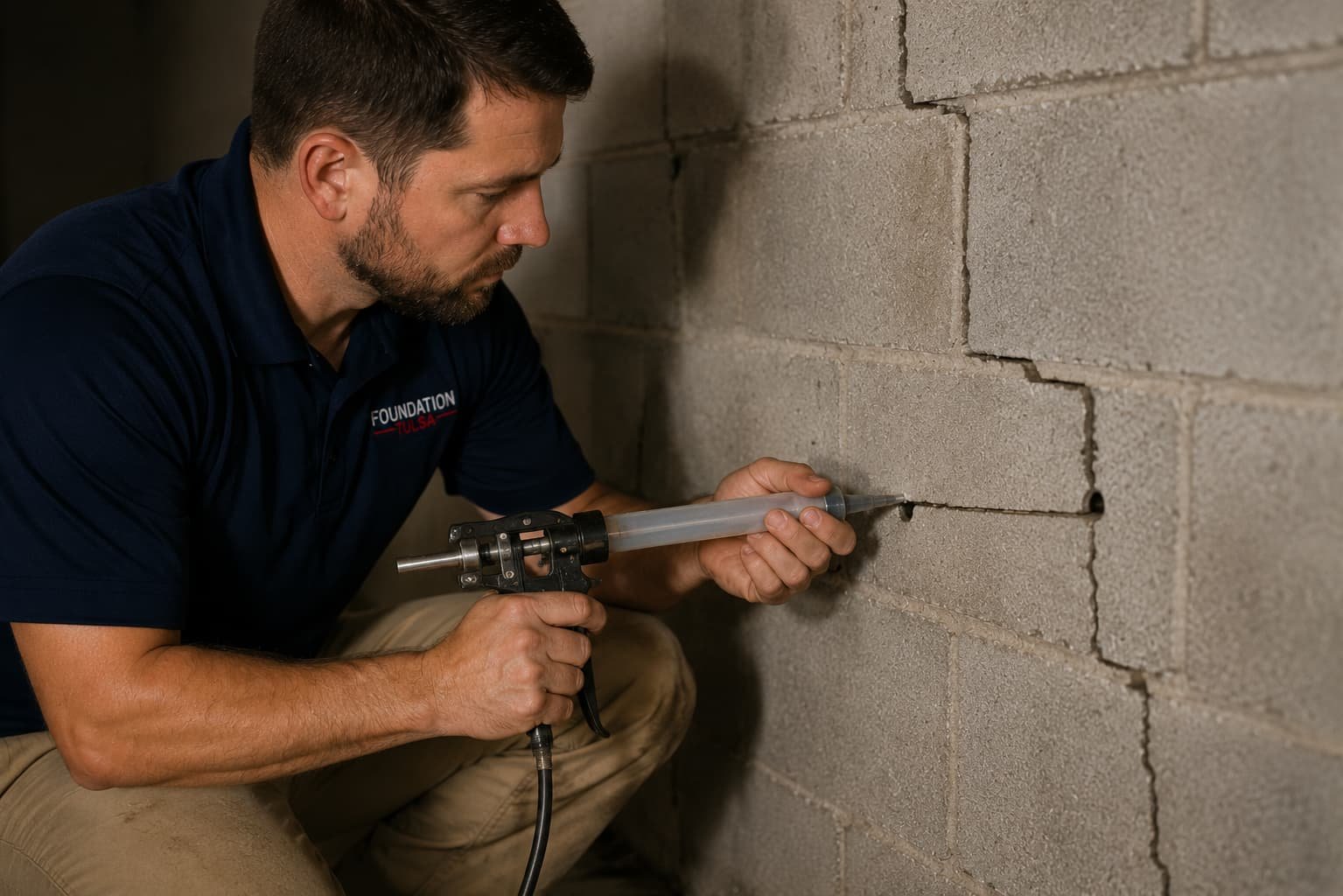
Foundation Crack Repair Tulsa OK
Foundation crack repair is one of the most common services we perform for Tulsa homeowners, and for good reason. Oklahoma’s expansive clay soils put continuous stress on foundation walls year-round — swelling after heavy spring rains and contracting sharply during dry summer months. That repeated movement causes cracks to form in poured concrete walls, concrete block walls, and brick foundations across the Tulsa metro area. At Tulsa Foundation Repair, we diagnose crack types accurately and apply the correct repair method for each situation, rather than defaulting to a one-size-fits-all approach.
Not all foundation cracks are equal. A hairline shrinkage crack in a poured concrete wall is a very different problem from a stair-step crack running along mortar joints in a block wall, and both differ from a horizontal crack indicating lateral soil pressure. Misidentifying the crack type leads to the wrong repair — which means the problem returns, often worse than before. Our technicians are trained to distinguish cosmetic from structural cracks and to recommend repair methods that address the underlying cause, not just fill the gap.
Why Cracks Form in Tulsa Foundations
The geology beneath Tulsa residential neighbourhoods is the primary driver of foundation cracking in this market. The city sits on Pennsylvanian-age shales and the clay-heavy soils derived from them — particularly the Dennis and Parsons series that dominate midtown Tulsa, the Gilcrease Hills area, and much of south Tulsa toward Jenks and Bixby. These soils have a plasticity index that ranks among the highest in Oklahoma, meaning they expand and contract more dramatically than almost any other soil type in the region.
When these soils absorb moisture — during Tulsa’s wet spring season or after prolonged rainfall — they exert significant lateral pressure against foundation walls. When they dry out, the soil pulls away from the foundation, removing the lateral support that the wall depends on. This cycle, repeated over years and decades, creates the cracking patterns that Tulsa homeowners typically notice first in their basement walls or at the corners of window and door openings.
Older Tulsa neighbourhoods present additional crack risk factors. Homes in areas like Midtown, the Pearl District, and South Tulsa’s established suburbs were often built with concrete block foundations rather than poured concrete. Block walls have mortar joints at regular intervals — natural weak points where cracks tend to propagate. Stair-step cracking along these joints is a reliable indicator of differential settlement or sustained hydrostatic pressure and should never be left unaddressed.
Foundation Crack Repair Methods We Use
- Epoxy injection — The strongest crack repair method available. Two-component epoxy is injected under pressure through ports installed along the crack face. Once cured, the epoxy bond is stronger than the surrounding concrete. Best suited to structural cracks in poured concrete walls where load transfer across the crack is required. Not appropriate for active water infiltration cracks.
- Polyurethane foam injection — A flexible, expanding foam injected into cracks where water infiltration is the primary concern. Polyurethane expands to fill the crack completely and remains flexible after curing, accommodating minor future movement without re-cracking. Ideal for cracks with active moisture or where seasonal movement is expected to continue.
- Carbon fiber strap reinforcement — For cracks associated with bowing or inward wall movement, carbon fiber straps are bonded vertically to the wall surface to halt further movement and stabilise the wall. Straps are low-profile and do not require excavation. Often used in combination with crack injection on walls showing both cracking and deflection.
- Tuck-pointing and block replacement — For concrete block walls with deteriorated mortar joints or damaged individual blocks, mechanical repair through tuck-pointing and selective block replacement restores structural integrity before waterproofing or further stabilization work is applied.
Foundation Crack Repair Pricing in Tulsa
Crack repair costs depend on the crack type, length, depth, and repair method required. The following ranges reflect typical Tulsa residential jobs:
- Epoxy crack injection — $400–$800 per crack for a standard poured concrete wall crack up to 8 feet in length
- Polyurethane foam injection — $350–$700 per crack; lower material cost than epoxy but equally labour-intensive
- Multiple crack package — $1,500–$3,500 for homes with 3–6 cracks requiring injection; bundled pricing is typically available
- Carbon fiber strap addition — $1,200–$2,000 per strap when added to a crack repair scope
- Block wall tuck-pointing — $800–$2,500 depending on the extent of joint deterioration and number of blocks requiring replacement
A free on-site estimate is always the starting point. Crack repair is one of the most cost-sensitive jobs in foundation work — catching and repairing a crack at $500 today prevents the $8,000–$15,000 waterproofing system that becomes necessary once water infiltration is established and the wall begins to deflect.
Frequently Asked Questions
Which cracks are structural and which are cosmetic?
Vertical hairline cracks less than 1mm wide in poured concrete walls are typically shrinkage cracks from the curing process and are cosmetic in most cases. Horizontal cracks are the most serious — they indicate lateral soil pressure and require immediate professional assessment. Stair-step cracks in block walls indicate differential settlement and are structural. Diagonal cracks from corners of window and door openings indicate settlement and should be monitored or repaired depending on width and activity. Any crack that is wider at one end than the other, or that has changed in width over time, is active and requires professional evaluation.
Can I repair foundation cracks myself?
DIY crack fillers and hydraulic cement products sold at hardware stores address the surface appearance of a crack but do not repair the underlying structural issue or seal the wall against hydrostatic water pressure. In many cases, surface patching masks the crack from view while allowing water infiltration to continue behind the patch — accelerating deterioration of the surrounding concrete. Professional injection under pressure forces material the full depth of the crack and bonds to both faces. For any crack showing water infiltration, wall movement, or width greater than 3mm, professional repair is the only appropriate response.
How long does crack injection repair last?
Epoxy injection repairs in stable walls — where the movement that caused the crack has been addressed — are typically permanent. The cured epoxy bond is stronger than the concrete around it and will not re-crack at the injection point. If the underlying soil movement or hydrostatic pressure has not been addressed, new cracks may form adjacent to the repair. Our inspection process identifies whether soil or drainage issues need to be resolved alongside the crack repair to ensure a lasting result.
Will crack repair stop water coming through my basement wall?
Polyurethane foam injection is specifically designed to seal cracks against water infiltration and is highly effective for cracks that are the primary entry point for water. Where water infiltration is coming through multiple cracks, through block wall mortar joints, or through the wall-floor joint rather than through a discrete crack, a broader waterproofing solution including interior drainage may be needed. We assess all water entry points during the initial inspection and recommend the most cost-effective solution for your specific situation.
Service Areas
Our foundation crack repair service covers Tulsa and the wider metro area. For localised information, visit your nearest city page:
- Foundation Repair Broken Arrow
- Foundation Repair Owasso
- Foundation Repair Bixby
- Foundation Repair Jenks
- Foundation Repair Sand Springs
- Foundation Repair Sapulpa
Foundation cracks rarely stay the same size — Oklahoma’s soil movement means an unrepaired crack will almost always widen or lengthen over time. The National Foundation Repair Association advises homeowners to have any crack wider than 3mm or showing signs of water infiltration professionally evaluated without delay. Call Tulsa Foundation Repair at (918) 359-6999 or visit our Free Estimate page to book your inspection.
📞 Call (918) 359-6999